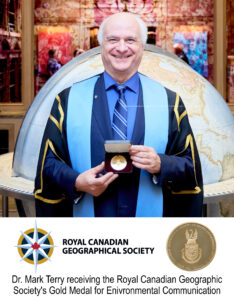
Dr. Mark Terry, Canadian scholar, explorer, and filmmaker is widely regarded as one of the world’s leading experts in Environmental Communication based on his work in a variety of fields and ability to share information. He teaches courses on ecocinema, geomedia, environmental communication, and film history as an adjunct professor in the Department of Communications and Media Studies, York University and the Departments of Communication Studies and Global Studies, Wilfrid Laurier University.
A member of the Royal Canadian Geographic Society (RCGS) since 2010, he received the RCGS 2026 Gold Medal for Environmental Communication. He’s been a member of The Explorer’s Club (Canadian Chapter) since 2012, The Royal Society of Canada since 2020, and following his work with the city of Vaughan, Ontario efforts to achieve their Sustainable Development Goals he became an invested member of the Order of Vaughan in 2020.
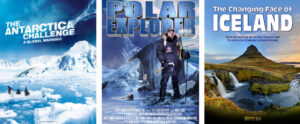 He led polar research expeditions resulting in his environmentally-based films including ‘The Antarctica Challenge – A Global Warning’, 2009, ‘The Polar Explorer’, 2010, and ‘The Changing Face of Iceland’, 2020, along with scientific papers including a a recent one following a glacier/water research expedition in Norway. Screening these films to world leaders and delegates at the United Nations COPs led to many press conferences and talks about climate change at the 17 COPs he attended and other venues, and being invited to sit down with policy makers to address the issue of melting glaciers and rising sea levels, resulting in forming the ‘Enhanced Action on Adaptation: Section II, Subsection 25 of the Cancun Accord’, addressing “the need to strengthen international cooperation and expertise to understand and reduce loss and damage caused by the adverse affect of climate change.”
In response to requests from The United Nations Framework Conference on Climate Change (UNFCCC) for more research projects following impactful screenings of his polar films, in 2015 Dr Terry launched The Youth Climate Report (YCR), a Geographic Information System (GIS) map creating a multilinear, interactive, database documentary platform on 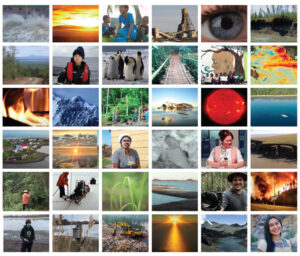 which to pin 3-to-5 minute films produced by international students taking on the role of researcher and reporter, adhering to themes and guidelines, spotlighting aspects of climate impacts and environmental issues and solutions found in their community or country. Over 1300 films, by youth from 170 countries, have been juried by Dr. Terry and the UNFCCC before being pinned on this visual data delivery system, along with metadata within the pin’s categories. Many films submissions were produced in Dr. Terry’s dozen or so international film workshops he’s held, including; four Planetary Health Film Labs with indigenous youth through the Dahdaleh Institute for Global Health Research; a five-year involvement with Wilfrid Laurier University’s ‘Activist Documentary Filmmaking for the United Nations’ and Ghana Films – Social Documentaries by Youth Videographers projects; NextGen Video Challenge through the University of Singapore; and Young Reporters for the Environment through the University of Copenhagen. The YCR map is regarded so successfrul by the UNFCCC helping to bridge the gap between science and policy makers, that is was adopted as an official UNFCCC form of communication in 2016.
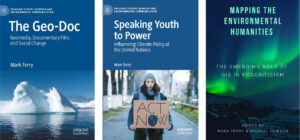 Dr. Terry’s research in the field of environmental communications is documented in the critically-acclaimed book called The Geo-Doc: Geomedia, Documentary Film, and Social Change, 2020, and Speaking Youth to Power – Influencing Climate Policy at the United Nations, 2022, both published by Palgrave-MacMillan. Mapping the Environmental Humanities – The Emerging Role of Geomedia in the Environmental Humanities, 2022, was published by Rowman and Littlefield, was co-edited by Dr. Mark Terry and Dr. Michael Hewson, who each contributed a chapter.
As a professor and public speaker, Dr. Terry combines a facility with academic terms mixed with language that best reaches his targeted audience and makes complex thoughts easy to comprehend. He lectures on his experiences with the United Nations developing international environmental policy as well as a variety of academic subjects such as documentary film and theory, eco-cinema, climate change, and the polar regions, among other subjects.
Dr. Terry is an experienced media artist and researcher on many subjects (climate change, polar regions, documentary film theory, commercial theatre, exploration, and Hollywood musicals), speaking at many conferences on these topics. Having worked in the entertainment industry before returning to school in 2014 to get his Master’s and PhD, Dr. Terry has had the opportunity to write and narrate several projects for film and television and be involved in the practical side of production on many levels.