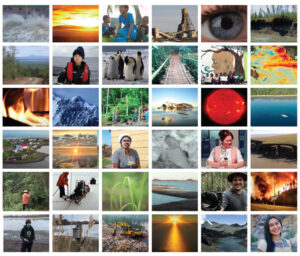
 Dr. Terry holds film labs for Canadian and international students who wish to become involved in Activist Documentary Filmmaking by making a 3 to 5-minute documentary film suitable to populate the United Nations Framework Conference on Climate Change (UNFCCC) project, The Youth Climate Report (YCR). Videos made by participants in his filmmaking workshops are added to the evolving data delivery system, The Youth Climate Report map. The film labs provide training, and guidance to students creating documentary films on the subject of climate change research and highlighting environmental issues to inform and education UN policymakers and beyond. All videos are juried by Dr. Terry and the UN. Successful submissions are added to the more than 1300 videos representing 170 countries already pinned to The YCR GIS map of the world representing climate research, impacts, and solutions on all seven continents. As Executive Director of the YCR, Dr. Terry is uniquely positioned to train participants and facilitate getting student films in front of UN policymakers and world leaders who jury them before they are uploaded to this evolving interactive documentary data delivery system.
Visit The Youth Climate Report Youtube Channel
Program Overview for Dr. Terry’s Film Labs:
Learning Outcomes – By the end of the program, participants will have learned:
- how documentary film is used as an influential communications tool to inform UN policymakers and for environmental activism;
- how to produce digital media projects and GIS maps;
- the value and process of collaborative filmmaking;
- how to conduct professional interviews with researchers and practitioners;
- how to deliver oral presentations; and
- how planetary health research can influence policy and practice
Stories
Participants create short documentary films about planetary health and the impacts of climate change on human health and wellbeing in their communities. General themes are planetary health, global health and humanitarianism, global health foresighting, and the Sustainable Development Goals. The films may tell a narrative and/or communicate research that touches on any of the following:
- the relationship between environmental and human health
- specific issues created or exacerbated by climate change, such as water safety, displacement, conflict, food shortages, changing patterns of infectious diseases, floods, and droughts
- how the humanitarian sector is responding to climate change;
- innovative or creative solutions to climate change
- innovative or creative health adaptations to climate change impacts;
- visions for a healthier future and how to get there
- how the participants’ communities are pursuing one or more of the United Nations’ 17 Sustainable Development Goals
See the following links to films below for examples off submissions for the United Nations:
 Student Life Levy program ‘Activist Documentary Filmmaking for the United Nations’ at Wilfrid Laurier University, based in Waterloo, Ontario, Canada, saw eight students create mini-documentaries under the tutelage of Dr. Terry be added to the Youth Climate Report GIS map and showcased during the United Nations’ Sustainable Development Goals Action Awards ceremony from March 25 to 26, 2021. Click on link to view all eight student films.
Summer 2023 Films
Summer 2022 Films
The 2022 edition of the Planetary Health Film Lab was designed for Indigenous youth from 11 communities across Ecuador who have a story to tell about climate change and health and want to do so through film. These films were produced in the Indigenous languages of Kichwa and Shúar with English subtitles.
Summer 2021 Films
Twelve Indigenous participants from the Circumpolar Arctic learned to effectively tell stories that communicate data, research, and life experiences related to global and planetary health. The workshop teaches specific theories, techniques, and modes of social issue filmmaking and provides hands-on experience with new digital technologies and platforms.
Winter 2020 Films
The first workshop cohort featured environmental activists and emerging filmmakers from Canada, Australia, Ecuador, Colombia, India, and Italy. The Film Lab took these young filmmakers through an intensive five-day process to create a film which tells a story about the health impacts of climate change.
The Ghana Youth Videography Programme
Ghana Films: Social Documentaries by Youth Videographers in conjuction with Wilfrid Laurier University, Waterloo, Ontario, Canada
Dr. Terry oversaw the making of dozens of films designed to inform and educate regarding environmental issues Ghanian youth found important in 2022, 2023 and 2024. Subjects that took focus were Climate Change and Disability. The programme is an intensive educational experience under which youth aged 18-35 produce short documentaries on climate change in Ghana for UN policymakers. This series of grassroots social documentaries made by Ghanaian youth videographers is funded by the Social Sciences and Humanities Council of Canada (SSHRC Insight Development Grant). Many of the students joined Dr. Terry at COP to present their work.
