 The Royal Canadian Geographical Society’s (RCGS) 2026 Gold Medal for Environmental Communication was recently awarded to Dr. Mark Terry in ceremonies recognizing outstanding achievement in the fields of geography, education, science, and exploration, and for volunteering to assist the Society, on Nov. 4th, 2026, at RCGS headquarters in Ottawa, Canada.
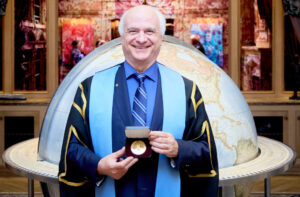 Dr. Terry was acknowledged for his work in multiple fields of communication, with the following introduction: “A scholar, explorer, and documentarian, Dr. Mark Terry has had a remarkable career as a leading figure in environmental filmmaking, pushing the medium to new heights.
Driven by his immense passion for science and adventure, Dr. Terry has produced environmental films on all seven continents, advancing the documentation of climate change across the globe.
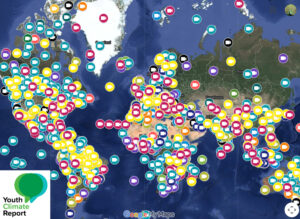 He is the founder of The Youth Climate Report, a database of more than a thousand environmental videos presented on a Geographic Information System world map. With this project, Dr. Terry pioneered a new technique in documentary filmmaking, the Geo-Doc, transforming the way spatial knowledge is collected and communicated.
Dr. Terry has contributed directly to climate policy, including the 2010 United Nations Cancun Agreements’ rising sea level framework, and is a dedicated climate educator.
He is a Fellow of the Royal Canadian Geographical Society and the Royal Society of Canada, and his many distinctions include The Explorers Club’s Stefansson Medal and the Academy of Canadian Cinema and Television’s Gemini Humanitarian Award.
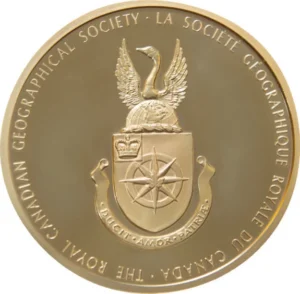 The Royal Canadian Geographical Society is hereby honoured to award the Gold Medal to DR. MARK TERRY in recognition of his outstanding service to environmental communication and education.”
When asked for a few comments on receiving this honour, Dr Terry stated: “I share this acknowledgment with the global community of researchers, filmmakers, UN policymakers, and young communicators who make the work that I do possible.”
As the speed of environmental change accelerated, it became clear to me that traditional, linear documentary storytelling needed to evolve, leading to the creation of the Youth Climate Report ‘Geo-Doc’, a multilinear, interactive, database-driven digital documentary platform designed to inform and influence policy by amplifying the voices of underrepresented communities who serve as Citizen Scientists and Journalists, by providing visible evidence of field research and experience. The platform was introduced at the Paris climate summit in 2015 and adopted by the UNFCCC as an official data delivery system, proving geographic technology isn’t just a record of our changing world; it is an active instrument of policy and global action.
In developing this platform, I drew deep inspiration from a giant of Canadian geography and a past Gold Medal recipient, the ‘father of GIS’, Dr. Roger Tomlinson, who revolutionized how we visualize and analyze space, teaching us that geographic data is most powerful when it informs better decision-making.
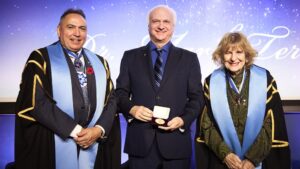
I extend my congratulations to the all of the RCGS 2026 awards recipients and thanks to my nominator, Governor Jett Britnell; the awards committee; Denis St-Onge, fellow Gold medallist; Francoise Baylis, President of the Royal Society of Canada; Lisa Phillips, President of York University; and Charles Hopkins, UNESCO Chair for Reorienting Education towards Sustainability for supporting my nomination.”
As mentioned, Dr. Terry’s films, articles, and books also contributed to his being awarded the Gold Medal. His films include: The Antarctica Challenge – A Global Warning, 2009; The Polar Explorer, 2010; The Changing Face of Iceland, 2021 and Turning Tides. His books and contributions include: ‘The Geo-Doc’ – Geomedia, Documentary Film and Social Change; ‘Speaking Youth to Power’ – Influencing Climate Policy at the United Nations; and ‘The Emerging Role of Geomedia in the Environmental Humanities’. His published papers can be found listed on Dr. Terry’s CV.