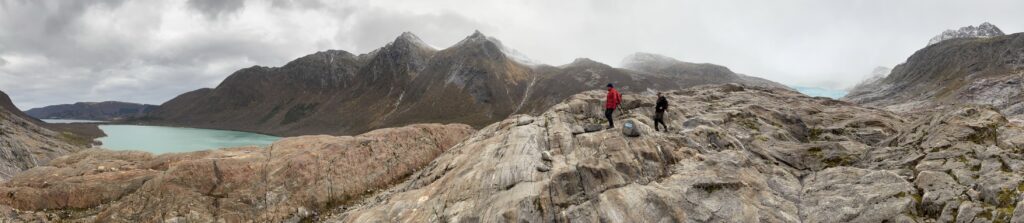
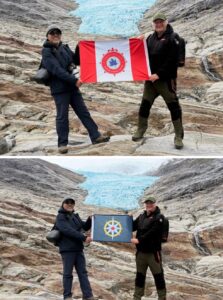
 In October of 2025, Dr. Mark Terry led a scientific team on a Flag Expedition on the Svartisen Glacier, located 300 miles from Bodø, Norway, for the Royal Canadian Geographical Society (RCGS). It is a rare privilege to be entrusted to carry both the flags of the Explorers Club (Canadian Chapter) and the Royal Canadian Geographical Society. The team proudly brought both to the Arctic in Norway for this Svartisen Glacier Expedition 2025.
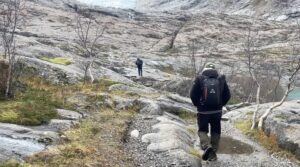
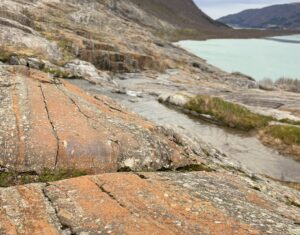
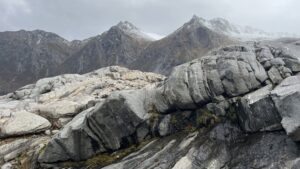
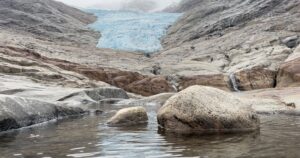
They climbed jagged, often slippery rocks, and leaped over rivers to reach a spot in front of Europe’s second-largest glacier and collected current data on sea surface temperatures (SST) and salinity measurements here and in the Norwegian Sea / North Atlantic Ocean as well as some detailed imagery of the glacier itself.
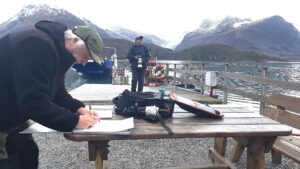
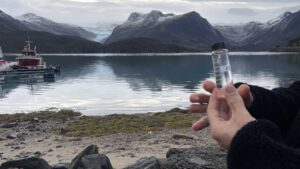
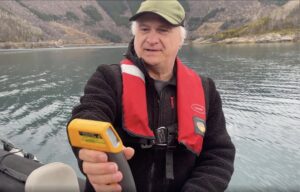
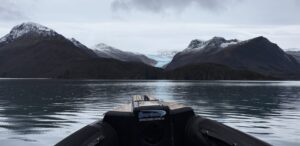
Team members recorded the first readings on the ground shore side of Svartisvatnet before crossing the lake by boat. Measurements of surface temperature and salinity from the ground shoreline were compared to those taken from the glacier shoreline and the middle of the lake.
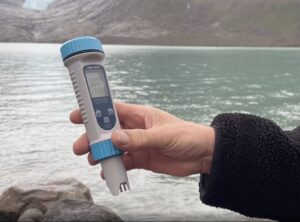 Dr. Terry’s paper ‘Hydrological and Thermal Observations from the Svartisen Glacier and Adjacent Water Bodies, October 2025‘ summarizes the scientific data collected on this expedition. It describes the teams discovery of marine heat waves in the Norweigan Sea/Atalantic ocean. The team detected a temperature of 10.7 celsius when the normal state for that area in October was solid ice with an average temperature of 0.7 degrees celsius. Another finding centered around the salinity measurements which turned up a huge decrease in the water’s salt content, proof that the fresh water melting off the glacier is making a significant contribution to the desalination of the Altlantic in the high Arctic. Such decreases in salinity make it harder for marine life to exist in that area, thus marine life leaving the area for more suitable conditions is becoming more and more common.
Special thanks to our partners UNITAR, the Young Lives Research Lab, the Planetary Health Film Lab, the Youth Climate Report, Nord University, York University, and Wilfrid Laurier University.